Mother, Witch, Monster, Guide, Milagros Rojas
27 de septiembre - 20 de diciembre de 2025
jueves a viernes, 15h-19h y sábado, 11h-15h
Calle Mexicaltzingo 1343, Americana 44160 Guadalajara, Jal.
ES
La arquitectura se despliega como un dispositivo de repetición, superficies que producen un orden que se multiplica hasta volverse amenaza, como en los laberintos y en otros lugares donde ese mecanismo se incrementa con imágenes colgadas en sus paredes siguiendo la misma lógica. O como en las oficinas, esas oficinas recubiertas de madera, las imágenes colgadas en la pared refieren a la práctica misma en la que se trabaja, si es una oficina de agrimensores entonces habrá mapas. La aparente solidez encierra un vacío. Blaise Pascal solía ver una espiral en su mano izquierda. Le aterraba el silencio de los espacios infinitos, un silencio cósmico y existencial, que se contraponía a las ideas antropocéntricas que sostenían que la humanidad era el centro de la creación.
Lo raro y lo extraño siempre escapan a cualquier posibilidad de categorización, funcionan como encarnación de lo desconocido y como amenaza al orden establecido, la superficie se expande para abrirse a un espacio vasto de posibles relaciones.
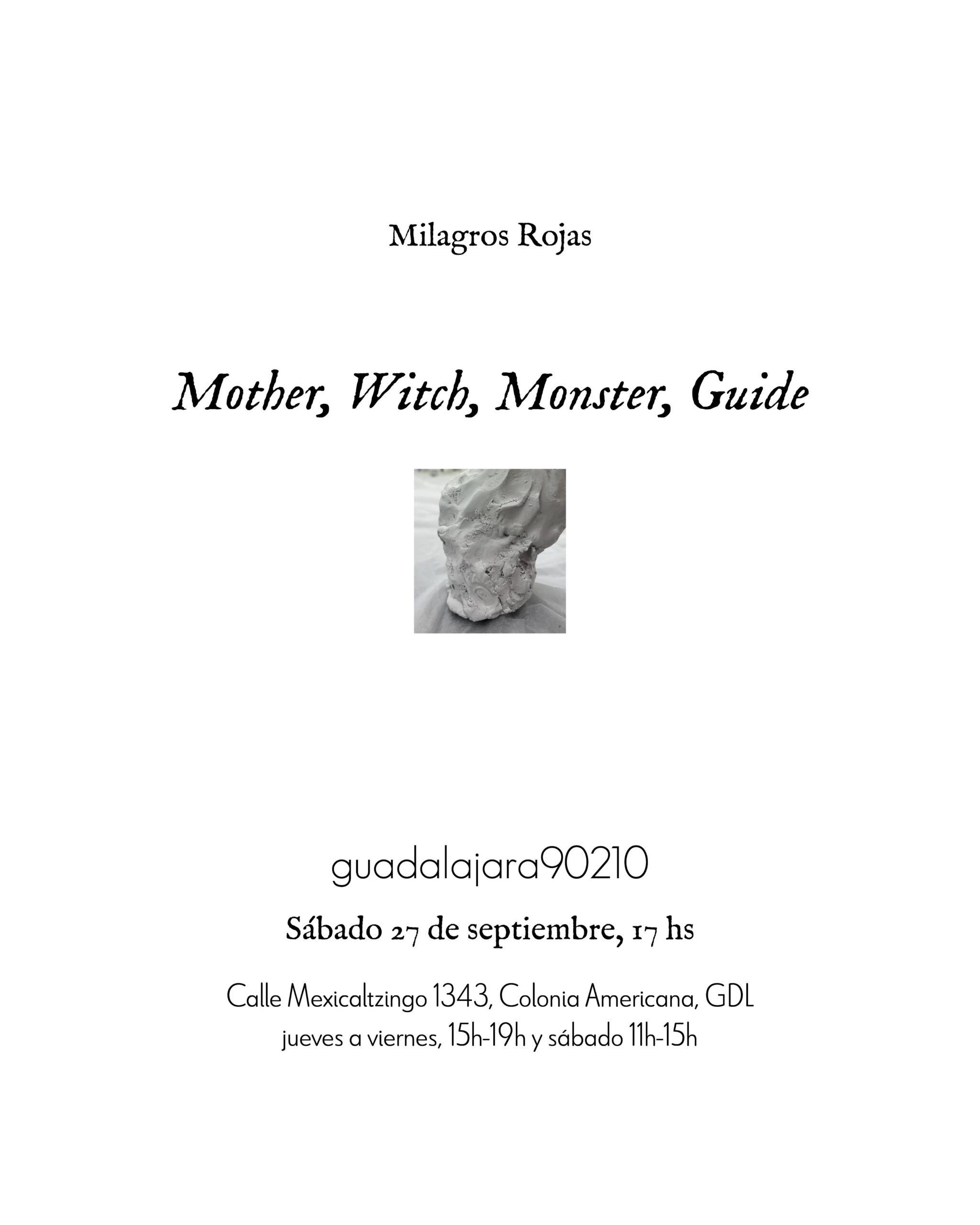
Así, en Mother, Witch, Monster, Guide Milagros Rojas, despliega una obsesión con la idea de la superficie incorporando esculturas que buscan abstraerse hasta llegar a esa idea de lo plano como potencia. En el dibujo donde esta vez el paisaje se expande y se contrae, se estira hacia los bordes disfrazado en la visión de un ojo mecánico y distorsionado y se absorbe completo en una espiral. En Trickery el zorro actúa como figura de la trampa o del engaño, del borde, de la fractura; el plano total en la escultura y la relación con el doble en Flat Narcissus; finalmente la distorsión mencionada en Pleasure and Anxiety que contra la idea de linealidad histórica o de progresión teleológica propone formas de pensar más rizomáticas, donde no hay un inicio y un fin, sino desplazamientos, torsiones y retornos, los huesos en el dibujo como transformación, la espiral que se repite en el espacio expositivo que se recorre.
Bajo esta orden de pensamiento, este mecanismo señala un gesto anti-lineal que permite estar en superficie y en profundidad al mismo tiempo: es plano y volumen, repetición y fuga. Esa tensión —entre superficie y fuga— organiza la obra de Rojas. En este escenario, lo plano nunca es únicamente plano, sino un espacio de apertura hacia lo intermedio, un lugar donde se pliega otra dimensión.
EN
Architecture unfolds as a device of repetition, surfaces that produce an order that multiplies until it becomes a threat, as in labyrinths and in other places where that mechanism is increased with images hung on the walls following the same logic. Or as in offices, those offices paneled in wood, the images hung on the wall refer to the very practice carried out there, if it is a surveyor’s office then there will be maps. Apparent solidity encloses a void. Blaise Pascal used to see a spiral in his left hand. He was terrified by the silence of infinite spaces, a cosmic and existential silence that stood in contrast to the anthropocentric ideas that sustained that humanity was the center of creation.
The strange and the uncanny always escape any possibility of categorization, functioning as embodiments of the unknown and as a threat to the established order, the surface expands to open up to a vast space of possible relations.
Thus, in Mother, Witch, Monster, Guide Milagros Rojas unfolds an obsession with the idea of the surface incorporating sculptures that seek to abstract themselves until reaching that idea of flatness as potential. In drawing, where this time the landscape expands and contracts, stretching toward the edges disguised in the vision of a mechanical and distorted eye and wholly absorbed in a spiral. In Trickery the fox acts as a figure of the trap or of deception, of the edge, of the fracture; total flatness in sculpture and the relation with the double in Flat Narcissus; finally, the distortion mentioned in Pleasure and Anxiety which, against the idea of historical linearity or teleological progression, proposes more rhizomatic ways of thinking, where there is no beginning and no end, but displacements, torsions, and returns, bones in drawing as transformation, the spiral that repeats itself in the exhibition space that is traversed.
Under this order of thought, this mechanism points to an anti-linear gesture that allows being on the surface and in depth at the same time: it is flatness and volume, repetition and flight. That tension — between surface and flight — organizes Rojas’s work. In this scenario, flatness is never only flat, but a space of opening toward the intermediate, a place where another dimension folds in.
ES
Milagros Rojas (n. Azul, Argentina, 1985) Artista visual y escritora radicada en Ciudad de México. Participó de muestras individuales y colectivas tales como Territorios liminales (2025) en Peana; Shudders and Perforations (2024) en Deli Gallery; Anteanoche (2023) en Commonwealth and Council, Harvester (2023) en guadalajara90210; entre otras. Desarrolla su trabajo desde múltiples disciplinas con las que investiga las implicancias del lenguaje alfabético y cómo este afecta nuestro entorno. En sus últimos trabajos utiliza el textil, el dibujo y la escultura como punto de partida para crear diferentes proyectos relacionados a temas como magia, traducción, fantasmagorías, paisaje y abstracción entendidas como potencialidades disruptivas frente a una lógica tecnocrática que regula el lenguaje y el cuerpo.
EN
Milagros Rojas (b. Azul, Argentina, 1985) Visual artist and writer based in Mexico City. She participated in solo and group shows such as Territorios liminales (2025) at Peana; Shudders and Perforations (2024) at Deli Gallery; Anteanoche (2023) at Commonwealth and Council; Harvester (2023) at guadalajara90210; among others. She works from the perspective of multiple disciplines with which she researches the implications of alphabetical language and how these affect our surroundings. In her most recent works, Rojas uses textiles, drawing and sculpture as a starting point to create different installation projects relating to themes such as magic, translation, phantasmagoric, liminal, landscape, and abstraction, thinking of them as disruptive potentialities against the technocratic logic that regulates language and the body.